
Lecture “Bringing Cosmopolitanism Down to Earth”
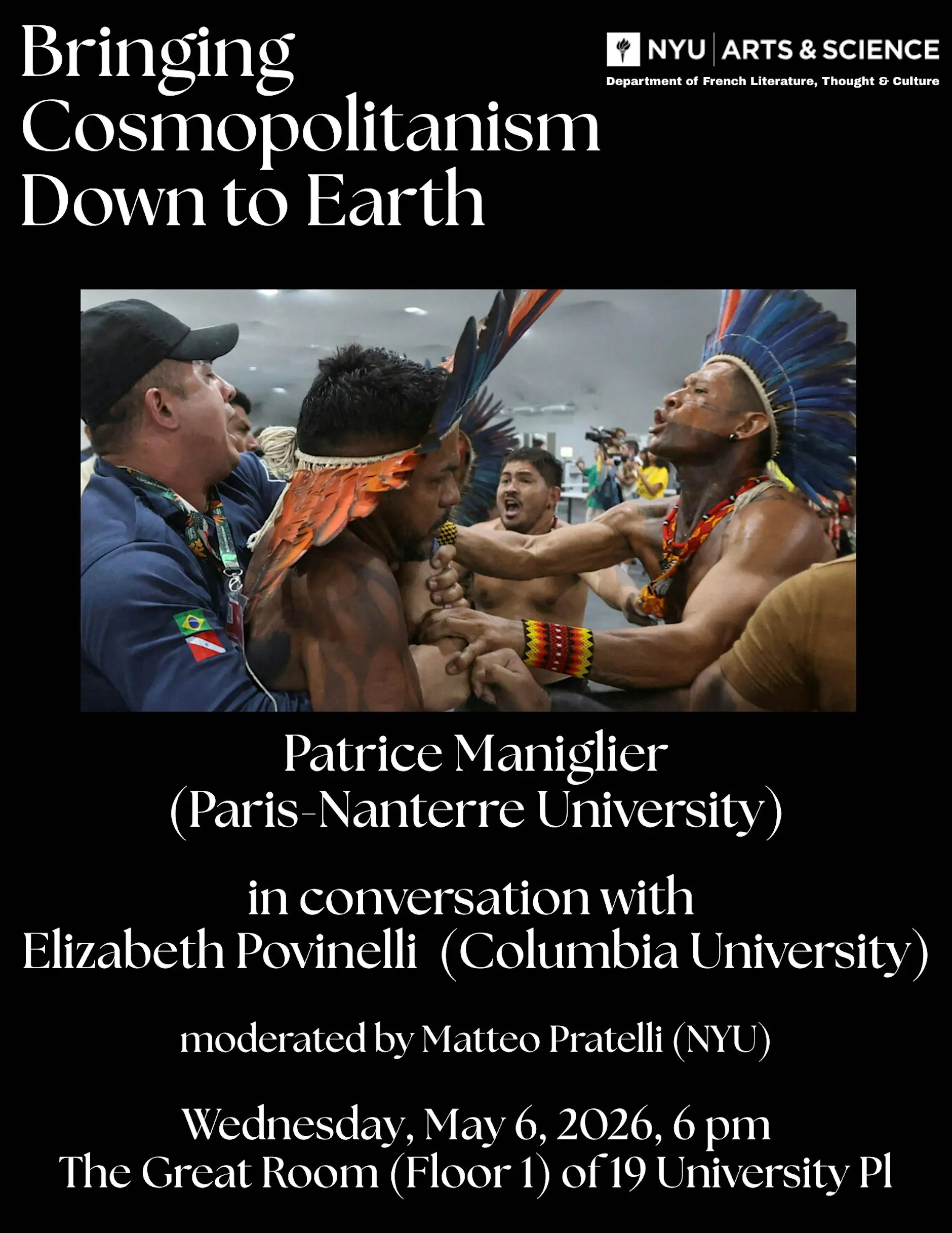
Patrice Maniglier in Conversation with Elizabeth Povinelli
Cosmopolitanism is no longer in vogue. It is criticized for being the ideology of the ungrounded globalized elites, either too woke or too neoliberal. The crisis of cosmopolitanism is one symptom among many others of the exhaustion of globalization both as a material and as an intellectual process.
This lecture will argue, however, that the cosmopolitical tradition is worth being revived precisely today, at a time when the globe hits the planet, when the Earth has entered the political and historical scene of human conflicts. It will argue that the cosmopolitical tradition, through its various guises (ancient, modern, and postmodern), has provided concepts of identity, difference, space, and agency that are particularly suited to deal with the challenges of contemporary Earth politics. Indeed, the Earth is not something that unifies humanity over and above its political divisions; rather, it entangles distant territories to the extent that urban capitalist ways of inhabiting one territory necessarily overlap with many others. A decision made about public transportation in New York contributes to floods or drought in Bengal, for example.
Through cosmopolitical institutions providing political rights to entities (both human and other-than-human) foreign to itself, a political community could internalize its contribution to the Earth’s futures. Far from being ungrounded, cosmopolitanism is the best chance that urban complex societies have to come, as Bruno Latour said, “down to Earth.”
Patrice Maniglier
Patrice Maniglier is Maître de Conférences in the Philosophy Department at Paris Nanterre University. A specialist in contemporary French philosophy, the philosophy of social sciences (especially linguistics and anthropology), aesthetics, and film theory, he is the author of La Vie énigmatique des signes: Saussure et la naissance du structuralisme (2006), Le Vocabulaire de Lévi-Strauss (Ellipses, 2002), La Perspective du Diable, Figurations de l’espace et philosophie, de la Renaissance à Rosemary’s Baby (Actes Sud, 2010), and Foucault va au cinéma (Bayard, 2011). He is a member of the editorial board of the journal Les Temps Modernes and co-directs the “MétaphysiqueS” series at Presses Universitaires de France.
Elizabeth A. Povinelli
Elizabeth A. Povinelli is the Franz Boas Professor of Anthropology and Gender Studies at Columbia University, where she has also been the Director of the Institute for Research on Women and Gender and the Co-Director of the Centre for the Study of Law and Culture. She is also a Corresponding Fellow of the Australian Academy of the Humanities and a founding member of the Karrabing Film Collective and has received a Doctor Honoris Causa from the University of Antwerp. Povinelli’s academic work has focused on developing a critical theory of settler late liberalism and its aftershocks, elaborated across eight monographs and numerous essays.
Geontologies, A Requiem to Late Liberalism was the recipient of the 2017 Lionel Trilling Award. She has also explored similar themes in a series of artworks shown in galleries and museums, including Prometeo Gallery, Milan, ar/ge gallery, Bolzano, the Biennale Gherdëina, MADRE, Naples, and Wiels Centre for Contemporary Art, Brussels. Her film, The Inheritance, made with Thomas Bartlett, premiered at Taxispalais, Innsbruck.
A series of her drawings reimagining prehistory as a series of colonial sedimentations was part of the reopening of the Museo delle Civiltà, Rome, in 2022. With her Karrabing colleagues, Povinelli has also participated in eight award-winning films, prizes of which include the 2015 Visible Award and the 2021 Eye Prize from the Eye Filmmuseum, Amsterdam.
Matteo Pratelli
Matteo Pratelli is a graduate student in the French Department of NYU and a member of the Executive Committee of the French Collective and Journal Les temps qui restent, where he has recently published an article called “La psychanalyse pense-t-elle à notre bonheur?” (“Does psychoanalysis think about our happiness?”). Trained as a philosopher, his fields of interest are French structuralism, psychoanalysis, and queer theory.
Location: 19 University Place, The Great Room, New York, NY 10003
Time: 6:00 pm EST
Free!

