
Webinar “From Sound to Species: Build Ecoacoustic Recognisers with Ecosounds & Perch”
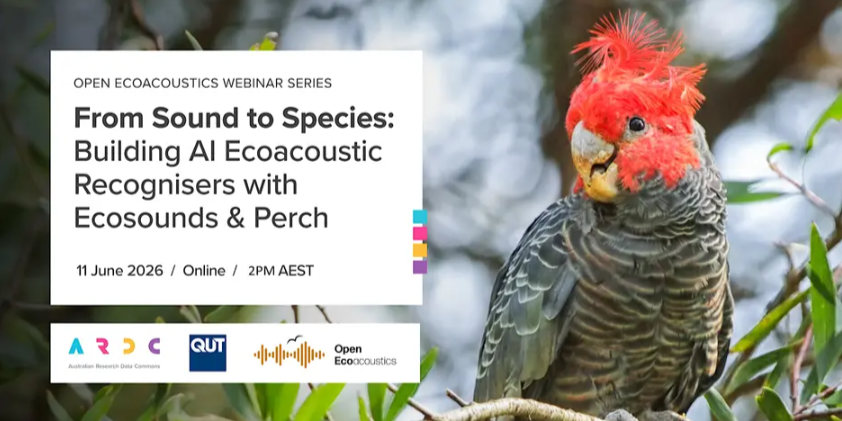
This webinar introduces an approach to building ecoacoustic recognisers by combining the strengths of Ecosounds and Google Perch.
About this event
Join us for this webinar in the Open Ecoacoustic Webinar series, where we introduce a practical, accessible approach to building ecoacoustic recognisers by combining the strengths of Ecosounds and Google Perch.
Environmental audio is being collected at an unprecedented scale—but turning thousands of hours of recordings into usable ecological insight remains a major challenge. Designed for research infrastructure providers, ecologists, and data practitioners, the session will walk through how modern AI techniques—specifically embedding-based recognition—can dramatically reduce the effort required to detect species in complex soundscapes.
Participants will be guided through the end-to-end workflow:
- Brief tour of managing large audio datasets within Ecosounds, new reporting tools, and a glimpse into call detective
- Using Perch to generate acoustic embeddings from raw recordings and creating a custom recogniser
- Then running the recogniser across large collections, and finally sharing the recogniser
The webinar will include practical examples, highlighting how these tools can be deployed within existing research infrastructure and data platforms.
Who will be speaking?
Philip Eichinski, Senior Research Software Engineer, QUT Ecoacoustics.
Dr Anthony Truskinger, Research Software Engineer, QUT Ecoacoustics.
Who should attend?
- Ecologists and biodiversity researchers
- Ecoacoustic practitioners
- Environmental data scientists and AI/ML practitioners
- Research software engineers and technical support staff
- Government, conservation, and environmental monitoring organisations
About Open Ecoacoustics
Australia’s biodiversity crisis necessitates urgent action to deliver continental-scale monitoring and management of threatened species and ecosystems. The Ecosounds platform aids ecoacoustics monitoring of these environments.
The project’s vision is to enable open science and conservation through the development and promotion of series.
The Open Ecoacoustics project provides the dedicated Ecosounds platform to allow anyone to store, process, and share passive acoustic sound recordings with downstream services. The project is supported by the ARDC and supports FAIR data by developing standardised metadata and third-party analyses by moving to flexible workflow technologies. Open Ecoacoustics accelerates data analysis by publishing a shared repository of annotated datasets and recognisers. The project interfaces to other systems, including TERN, ALA, EcoCommons and citizen science sites, through services and shared tools.
Further ARDC resources
- Open Ecoacoustics
- Learn about Planet RDC
- Find environmental science resources
Will the session be recorded?
Yes, the session will be recorded. The recording will be provided to all registrants and published on the ARDC YouTube channel.
About the ARDC
At the Australian Research Data Commons (ARDC), we’re accelerating Australian research and innovation by driving excellence in the creation, analysis and retention of high-quality data assets. We partner with the research community and industry to build leading-edge digital research infrastructure to provide Australian researchers with a competitive advantage through data.
The ARDC is enabled by the Australian Government’s National Collaborative Research Infrastructure Strategy (NCRIS).
Learn more at the ARDC website.
To keep up-to-date on the latest digital research news and events, subscribe to the ARDC Connect newsletter
Have questions?
Email: Andrew at contact@ardc.edu.au
Please note that this event may be recorded, and the recording may be published by the ARDC. This may include your contributions during the session. Attendees are expected to comply with the Code of Conduct for ARDC Activities during this event. The ARDC respects the privacy of individuals. Information collected is in accordance with the ARDC Privacy Policy.
Check out our Communities of Practice — Explore and join the many digital research and data communities and groups we facilitate for information exchange, best practice, problem solving, and peer support.
Time: 11:00 pm EST
Free!

